Saturday, February 26, 2022

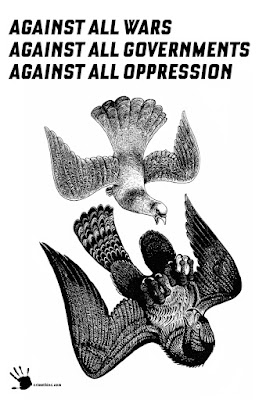
Stop the Wars


As the Russian invasion of Ukraine grows increasingly brutal, we say to our fellow workers in all lands that we have no quarrel with you. On the contrary, we appeal to workers in all other lands to refuse to slaughter one another for and at the behest of, our capitalist masters. We appeal to you to unite with us in the struggle to overthrow the system of capitalism which not only causes war but all the other social problems which our class endures throughout the world.


 Putin is not acting from a belief in self-determination, but from naked Russian nationalism.  That is what is so amusing about those supporting him against the nationalists of Kyiv. Russian capitalism intends to use its power in order to implement its long-standing imperialist and expansionist aspirations. In Russia, Putin’s regime is trying to stoke Russian nationalism to divert attention from the growing workers' socio-economic problems: poverty wages and pensions, dismantling of available health care, education and other social services. In the noise of the nationalist and militant rhetoric, it is easier to complete the formation of a corporate, authoritarian state based on reactionary conservative values and repressive policies.


We will not succumb to the nationalist poison. To hell with their “nations” and their flags.


Friday, February 25, 2022

Capitalism’s war drums are never silent.


The Russians have invaded Ukraine and once more men, women and children are in the front lines of what could be a bloody conflict. 


When the ruling class talk of war it is more than ever necessary for the workers in this country to remember that the workers in other countries have as little direct responsibility for their callous ruling class and bloody-minded military as we have for ours. Almost no wars in history have ever been decided on by the people who were called on to fight them.


War cuts across the basic identity of interest of the workers of the world, setting sections of them at enmity with each other in the interests of the capitalist class. Its effect is wholly evil. It depraves all the participants by forcing them to concentrate and commit misery and killing upon each other. It elevates lying, and murdering opponents into virtues, it confers honours on those who practise these means most successfully. Men and women have the vile methods of warfare imposed on them and are filled with the idea that violence and not mutual understanding is the final solution to all problems. Many of those who have been subjected to the atmosphere and atrocities of war remain addicted to violence or traumatised by it when hostilities have come to an end. War cannot be humanised. Its brutalities will cease only when capitalism, which is the cause of wars, has been brought to an end.


We condemn the system of social organisation that creates conditions in which civil wars can all happen — a system where it must always be "You or I" and rarely "You and I". Socialists point out and explain the war existing in society - the class war -  must be won before we can end the cause of wars.  Wars are not about freedom and democracy. That's just a convenient slogan. Wars are part of the more violent ongoing competition for profit and power in the world. When negotiations finally break down, the ultimate form of competition is war. The only war — if you want to call it that — for freedom and democracy that British people have been involved in was against our own ruling class. Atrocities are going on all the time in different countries, and other nations do little or nothing about them — unless they want to use them as propaganda. Governments talk about human rights and freedom when it suits them, but if you look at their actions it's just hogwash. They are completely devoted to protecting and expanding possessions and profits and power — utterly regardless of human beings. Whoever wins a war, the people always loses — on both sides.


We can fully understand the desire to stop a war and socialists are opposed to wars in all its forms. But first and foremost we are opposed to the capitalist system which gives rise to war. There are plenty of sincerely motivated people who are deeply committed to “peace". Such aims are utopian unless they are related to the historical possibility of establishing a class-free state-free society.


 Understanding that capitalism causes wars, socialists urge the need for conscious political action to end capitalism and thus eradicate war. The Socialist Party has often stood alone in condemning war from a class angle. Frequently alone among all political parties in Britain, the Socialist Party has never supported one capitalist interest against another in a war. We have refused to be tricked into support for legalised killing and consistently we have argued that workers have a material interest in opposing all wars. For workers, there is but one way ahead and that will never be in the company of capitalists of any nation.

Peace Train (music video)


Sunday, January 23, 2022

The World Socialist Movement


The socialist movement is not only the heart, but is a combination of heart plus head.


It is almost a truism to say that when the workers, as a class, couple their latent revolutionary fervour with socialist understanding, they become an indomitable force sweeping everything before it. 

“Nothing is more powerful than an idea come of age, it is more powerful than the strongest armies.” 


As to any fears that there is no room for differences of opinion in a socialist party, this simply isn’t so. Socialists have varying opinions on matters of a speculative nature, on interpretations of current events, on attitudes to cultural matters, specific aspects of science, even on projections of the actual workings of a socialist society.


Saturday, December 25, 2021

Blue Xmas (Music Video)


Blue Xmas (To Whom It May Concern).

Merry Christmas
I hope you have a white one, but for me it’s blue

Blue Christmas, that’s the way you see it when you’re feeling blue
Blue Xmas, when you’re blue at Christmastime
you see right through,
All the waste, all the sham, all the haste
and plain old bad taste

Sidewalk Santy Clauses are much, much, much too thin
They’re wearing fancy rented costumes, false beards and big fat phony grins
And nearly everybody’s standing round holding out their empty hand or tin cup
Gimme gimme gimme gimme, gimme gimme gimme
Fill my stocking up.
All the way up.
It’s a time when the greedy

give a dime to the needy
Blue Christmas, all the paper, tinsel and the fal-de-ral
Blue Xmas, people trading gifts that matter not at all
What I call
Fal-de-ral
Bitter gall…….Fal-de-ral

Lots of hungry, homeless children in your own backyards
While you’re very, very busy addressing
Twenty zillion Christmas cards
Now, Yuletide is the season to receive and oh, to give and ahh, to share
But all you December do-gooders rush around and rant and rave and loudly blare
Merry Christmas
I hope yours is a bright one, but for me it’s blue.

Bob Dorough
http://en.wikipedia.org/wiki/Bob_Dorough

Friday, December 03, 2021

assimilationism

So Tony Blair has chosen to be British society's guardian. He has criticized multiculturalism as being a cover for immigrants who refuse to integrate into the British way of life. Until recently the dominant opinion amongst those in charge of the British state was to make a virtue of necessity and pursue a policy of “multiculturalism”. It didn’t work. In fact, it has encouraged division, by getting people to identify with their “culture” rather than with the British “nation”.

https://www.theguardian.com/politics/2019/apr/20/tony-blair-says-migrants-must-integrate-to-combat-far-right

Anders Breivik, who carried out the Norwegian slaughter berated what he called in his manifesto  “Marxist multiculturalism”. 

Gary Younge once pointed out in the Guardian : “Cultures are dynamic, and emerge organically from communities. None exist in isolation or remain static. So the presence of a range of cultures in Britain or anywhere else is not novel, but the norm.” There’s nothing wrong with that. A diversity of languages, festivals, music and food is something to be welcomed and enjoyed.

The other kind of multiculturalism which advocates policies for encouraging and supporting cultural differences at the expense of working class unity is something to be opposed as much as the alternative policy pursued by some states of inculcating a single “national identity”.
 Workers should be encouraged to think of themselves as members of a worldwide class with a common interest, not as members of different “nations” or different “ethnic” or “cultural” groups with their own different, competing interests.  We understand that working-class people of all cultures need to come together as equals to fight for issues that unite them as a class. And that’s the only way we’ll ever achieve a society where we can work together for things that unite us all as human beings, regardless of skin colour, religious beliefs, cultural or national origin, or individual difference.
Socialists see “multiculturalism” as divisive as it gets workers to identify with some other group over and above their class.

Immigration causes a problem since immigrants, having been brought up under some other state, have not gone through the same process of brainwashing and conditioning as have the “native” population. Those born and brought up in Britain have been taught, through what’s been drummed into their heads at school and through what they continuously hear on the media, to regard themselves as British. In school, they are taught the history of the kings and queens, and of the wars in which the British ruling class has been involved over the centuries. The media reinforce this by reporting news from an almost exclusively British angle and encourage identification with “the nation” via identification with “our” sports teams and performers. Who can forget that once doyen of conservatism, Norman Tebbitt’s annoyance, refuse to support the English cricket team and continue to support that of their country of origin or that of their parents? 
Hence a change of policy is underway, a swing to “assimilationism” which  Blair's home secretary Blunkett began that people seeking British nationality should be required not just to have a knowledge of “the British way of life” but also to publicly swear allegiance to the queen. 


Saturday, November 13, 2021

Only One Solution: Revolution!

 Save the Planet - Destroy Capitalism!

UN Climate Conferences have been going on for 25 years. They have achieved precisely nothing. The participants at Paris in 2015 agreed to decrease production of oil, gas and coal by 6% a year for the next decade. Instead, according to the UN itself, they are planning increases of 2% annually, even as carbon emissions continue to mount.

It is undeniable that the continual rise in carbon emissions threatens life on earth through the process of global warming. Governments and Greens alike talk of ‘human beings’, ‘humanity’, or at the very least ‘primarily human activities’, as being responsible for the 48% increase in “the global average concentration of atmospheric carbon dioxide” over pre-industrial levels. (NASA’s October 2021 Newsletter.) Now, just before the Glasgow jamboree the latest IPCC study confirms that “it is unequivocal that human influence has warmed the atmosphere, ocean and land.” Increases in greenhouse gas concentrations have been “observed since around 1750 [and they] are unequivocally caused by human activities.” So, now we get the theory: around 250 years ago humans, homo sapiens, who have been on Planet Earth for almost 300 thousand years, abruptly changed their ‘activities’ and began polluting the atmosphere and destroying the natural environment as never before. This is no explanation.

The Climate Crisis is a Capitalist Crisis

Today’s ‘climate emergency’ cannot simply be attributed to general ‘human activity’. The IPCC evidence says it all: the massive increase in emissions of greenhouse gases since the 18th century coincides with the rise of capitalist industrial society, and has intensified as capitalism has become the undisputed mode of production over the entire planet.

Those who blame ‘human nature’ point to the consumption habits of the general population. They claim that this is at least equally responsible for the massive amounts of greenhouse gas emissions as the production processes for those very same products. Others repeat the Malthusian stance that overpopulation is the cause. These myths, the latter of which implicitly advocates mass genocide, both treat society as a collection of individuals, rather than a set of social relations. As such they fail to consider how class differences within capitalist society created and maintain the climate crisis.

The capitalist class owns the means of production and uses them to produce products solely for the purpose of exchange, so as to generate profit. The result for the working class is an absolute lack of alternatives. They have no means to produce the things they need themselves, and so must give their labour to an increasingly life-threatening production process in exchange for wages which they then use to buy the commodities that the process created. Anybody who chooses to produce goods through more ‘ethical’ means will be out-paced and out-priced by those who don’t. Capitalists compete for profit. To do so they expand production, ravage the earth’s ‘free’ natural resources and invest in machines that increase productivity. This incessant growth of capital is a means to an end that never ends. Climate change is not the result of a general human nature that can be traced back to hunter-gatherers; rather it is specific to capitalism, where profit and capital determine action. Capitalist states, which exist to protect their own (capitalist) economies, cannot stop the damaging consequences. No amount of climate summits or window dressing government pronouncements can protect the world’s working class from the increasing number of catastrophes.

Who Pays the Highest Price?

States, for their part, have obscured their true intentions. In Glasgow much will said about carbon taxes and promises of “net-zero emissions no later than 2050”, as Biden promised in his presidential campaign. However, millions of acres have just been leased by the Biden administration for the exploration of oil and gas. More tellingly, a recent US federal statute set up a Climate Security Advisory Council with the goal of assessing and working to counteract climate change’s effects on “national security infrastructure” and “potential political violence”. There is not even a token mention of attempting to mitigate climate change itself. The goal here is clear: while the working class suffers from natural disasters, famine and war, the states of the world are tooling up to protect the capitalist class from any threat to their power from the people they claim to protect. In other words, in a climate emergency capitalist states will operate in their usual manner, as protectors of capital and enforcers of private property. Climate change and its consequences are not treated as a disastrous possibility that must be stopped at all costs, but an inevitability whose costs must be accounted for and its consequences to be prepared for.

And there will be much to prepare for as the consequences of global warming will be devastating and the world’s poorest, including the working class, will feel the worst of it. We are already beginning to see its effects, as wildfires in the Amazon rainforest, Australia and California burned down over 50 million acres of land, destroyed thousands of homes and killed over 500 people in 2019-2020. In July 2021, in India, Europe and China, flooding killed over 700 people and over 1 million people had to be evacuated from the flooded areas. Rising sea levels will continue to exacerbate flooding and will submerge large sections of coastlines making them uninhabitable, destroying homes and displacing millions. The increase in heat will dry out crops leading to starvation and deadly famines, especially for those living near the equator. Migrants seeking refuge elsewhere, where they might find food, work or peace will be turned away, detained or will die travelling across dangerous terrain. This mass of misery is undeniably inevitable. The Syrian refugee crisis showed us just how capable the world’s richest states are at letting millions of desperate people fleeing a civil war die.

And the more the planet heats up, the more impossible it will be to reverse it, if at all. The melting of the ice caps will reduce the amount of reflected sun rays which will further increase global temperatures; the melting of permafrost will release huge stores of previously trapped greenhouse gases; the acidification of the oceans will kill most of the ocean’s plankton, the basis for the majority of the oceanic food chain; continuing deforestation will increase levels of CO₂ in the atmosphere as fewer trees will be able to absorb it; rising temperatures will further exacerbate water scarcity, a problem that already affects over two-thirds of the global population. Moreover, states’ humanitarian response to these tragedies will decline as they focus their efforts on maintaining civil obedience through the police and warring over dwindling resources with their armies.

Only One Solution: Revolution!

Our hope for the future doesn’t lie with politicians or CEOs. No international agreement will be able to reverse capitalism’s effects on the climate; no such agreement could even be enforced. The United States’ brief exit from the Paris Climate Accords from November 2020 to February 2021 shows the ease with which a powerful nation can suspend any supposed “commitment” to stopping climate change. With imperialist tensions mounting the cost of combating climate change will increasingly become an unnecessary expenditure.

The truth is clear: so long as capitalism survives, the habitable land on this planet will shrink and hundreds of millions will die prematurely. It is clear we need a new social model. We need a society which can take and adapt the technology that has been built, and use it for the satisfaction of human needs rather than the accumulation of wealth for a few. A society where decisions can be made by all for the benefit of all, and where the survival of human life on the planet is not under constant threat.

The above article is taken from the current edition (No. 57) of Aurora, bulletin of the Communist Workers’ Organisation.

Saturday, October 30, 2021

Cats and Dogs and the Planet

 Cats and dogs come with a steep carbon pawprint. This is mainly because of their diet, which includes a lot of meat and animal products.

  1. The meat consumption of cats and dogs in the US produces around 64 million tonnes of CO2 per year, the equivalent of a year’s worth of driving from 13 million cars, according to a 2017 study published in the journal PLOS One.

    The study found that cats and dogs are responsible for 25 to 30 per cent of the environmental impact of meat consumption in the US. A country made up of just cats and dogs would rank fifth in the world for meat consumption, after Russia, Brazil, the United States and China, the analysis concluded.

  2. “Pets have many benefits, but also a huge environmental impact,” said Gregory Okin, author of the study and a geography professor at the University of California, Los Angeles. 

  3. Dry pet food production emits 106 million tonnes of carbon dioxide each year, more than countries such as Mozambique and the Philippines, according to a 2020 study by researchers at the University of Edinburgh. 

  4. A country producing the same amount of carbon emissions would be the world’s sixtieth highest emitter, the researchers said. Dry food production for cats and dogs uses around 49 million hectares of agricultural land, roughly twice the size of the UK, annually, the study found.

    1. “Even accounting for the use of by-products in pet foods, the feeding of companion animals plays a role in environmental change. This is a topic that has been previously overlooked, but we have shown that pets and how they are fed should be considered alongside other actions to reduce climate change and biodiversity loss,” said Peter Alexander,  a senior researcher in food security at the University of Edinburgh.

  5. There are already sustainable plant-based products available made from chickpeas, lentils and soybeans.

    According to the Pet Food Manufacturers’ Association, insect-based pet food offers a nutritious, sustainable alternative to food made from animal products. Insects are rich sources of protein and often contain high fats, minerals and amino acids. Insect farming uses a fraction of the land, energy and water required for traditional agriculture, and has a significantly lower carbon footprint. While cows and sheep need huge swathes of pasture to graze on, insects can be reared easily in small spaces. Crickets produce up to 80 per cent less methane than cows, according to a study by researchers from the University of Wageningen in the Netherlands.

  6. Is getting a cat or dog bad for the planet? | The Independent

Wednesday, October 27, 2021

Libertaria: A Libertarian Paradise

 www.NewDemocracyWorld.org

Libertaria: A Libertarian Paradise

by John Spritzler

April 10, 2014

Most people have never heard of Libertaria (not to be confused with Liberia), so let me tell you a little bit about this most interesting nation. It is a veritable libertarian paradise. With a population of fifty million people and plentiful natural resources, Libertaria is truly blessed.

There is a government in Libertaria, but it is so minimal that the Libertarians hardly notice it. The government is barely more than just the administration of a modest military force to protect Libertaria from foreign invasion, and the military consists entirely of volunteers--no draft or forced conscription whatsoever. The government does not censor speech, press, the media or the internet in any way.

There are no laws of any sort in Libertaria regarding sex for consenting adults. Sure, there's a law against adults having sex with minors too young to give informed consent, but that's all.

There are no laws prohibiting adult possession or use of drugs. People are free to smoke, inject, snort or otherwise enjoy whatever substance they wish. If somebody harms him or herself, well, it's their right to do so as long as they don't harm somebody else in the process.

It probably goes without saying that there is no national ID card; privacy is honored in Libertaria. The only time you tell another who you are is when you want to, period!

There is no "corporate welfare" or government handouts to business in Libertaria. Corporations and businesses either thrive because they are better than their competition, or they fail otherwise. Likewise, there are no government barriers to international trade, no tariffs or sanctioned foreign nations one cannot trade with.

People in Libertaria don't rely on the "government teat" to support them in their old age. There is no government-run Social Security. There are private companies that people can invest in if, and to the extent, they want to, to provide income if and when they may choose to retire. People are free to invest for their future, or not, as they see fit. If they regret their youthful failure to invest for their old age, well, that's nobody's fault but their own. In Libertaria people are expected to take responsibility for their lives.

Although the government has nothing to do with it, people in Libertaria are perfectly free to give to charity, and to create charitable organizations to do that on a large scale. Those who wish to donate to the charity of their choice are free to do so; those who don't wish are free not to.

As one can imagine, taxes and government spending in Libertaria are as minimal as one could possibly imagine, given the need to operate a defensive military and enforce very minimal legislation.*

The Constitution of the government in Libertaria is just like the one in the United States. The difference is that the government of Libertaria understands the importance of not making stupid, counter-productive and unnecesssary laws--something that the government prides itself on very much.

What's Life Like in Libertaria?

Describing what life is like in Libertaria is not simple, because it is very different depending on how much money one has. A small number of people in Libertaria have an enormous amount of money--many billions of dollars for a single person, in fact. (Their currency is dollars, and one of their dollars happens to be worth one U.S. dollar at the time of this writing.) It didn't used to be this way.

Many generations ago, in a distant past period that has been pretty much lost to the memory of most living people in Libertaria, everybody in Libertaria owned essentially the same amount of wealth and had essentially the same income. But you know how things are: some were luckier than others, some were more clever than others, some had no siblings and inherited all their parents' wealth and others had to divide it up among lots of siblings, and so forth; after a while some ended up being a little bit wealthier than others.

And, no surprise here, people with a little bit more wealth than others had a little bit more influence than others. They were able to acquire more property. They bought land that other people owned. People who once were able to support themselves by working on their own land or working with their own tools or machines began to lose their property. Sometimes they were forced to sell it cheap because they farmed and bad weather destroyed their crop. Sometimes they had to sell their property cheap because they couldn't compete with a larger business selling the same commodity they did but at a lower price because economy of scale favored the larger business. Those who lost their property for one reason or another wondered if maybe something was unfair about what happened. But the transfer of their property to wealthier people didn't violate any of the laws of Libertaria, and it all seemed quite legitimate as far as the prevailing norms of the society went, so what could the poor losers do but resign themselves to their misfortune?

The wealthier, luckier, more clever people were free to acquire wealth without any government interference. They came to own little businesses that were larger than the others, and they were able to employ more employees than the others. They were the most successful of the self-employed. The less fortunate, the ones who had to sell the land or tools or machines they had once used to make a living as a self-employed person, had to work for an employer, as an employee.

And, things being the way they are, some little businesses won out in the competition with others and became big businesses, employing lots and lots of people and owning vast tracts of land or mines or huge factories and skyscraper office buildings. The owners of these big businesses became wealthier and wealthier. The big businesses had more power than the small businesses, and began to order the small businesses around, telling little suppliers, for example, that they would only pay them a low price: take it or leave it. And the little businesses "took it" because "leaving it" meant going out of business and having to work as an employee for some business.

To work as an employee in Libertaria was something people tried to avoid by being self-employed. But with the few extremely large corporations calling the shots, it just wasn't possible for very many people to succeed as a small business person; most ended up having to find work as an employee.

By the time we reach the present day in this brief history, there is extreme economic inequality in Libertaria. The vast majority of people are employees (or unemployed when, as often happens, they are laid off during economic downturns.) The few who own businesses are very well off; some are even billionaires. The economy works very well because there is no government interference messing it up with unintended consequences of well-intentioned legislation. Profits enrich the few. Businesses that make luxury items for the rich do very well.

At the same time, life is very hard now for the employees. The business owners pay their workers as little as possible, which is very little indeed because a worker has to take it or leave it, and leaving it means starving. People who can't find work receive, of course, no pay at all (although they might get some charity if they are lucky.) Wages might not be as low as they are if the workers had strong unions and could go on strike to win higher wages. But the culture in Libertaria is very much opposed to such collectivist solutions to problems. People are supposed to take responsibility for their own lives, and solve their own problems as individuals. Unions, it is felt, would take away from the freedom of the worker. If a union declared a strike, then a worker would be compelled to stay away from his or her job, against his or her own will: tyranny!

But even if the workers did have unions, what could they really accomplish? Unions don't object to capitalism, and in a free capitalist society if a business pays higher wages than its competition then it will eventually go out of business, and all of its workers will lose their jobs. If a union demanded substantially higher wages at one company, it would have to fight for higher wages in all of the other companies competing with it. But some of the competing companies are (or might become) located in nations other than Libertaria. The union would then have to organize workers all over the world.

Even then, however, the owners of the business could decide to just close shop, on the grounds that workers are demanding wages that make it impossible to make a profit. What could the union do then? The owners of the business own all of its productive wealth--its land and machines and buildings and intellectual property and so forth--and they are free (yes FREE, at least in Libertaria) to do with their property whatever they wish.

Alas, the workers in Libertaria live in abject poverty. They feel lucky to have any job at all, no matter how little it pays. The price and production of commodities is based on supply and demand. The impoverished workers have so little money that there is little demand (in terms of the number of purchasing dollars, that is) for the cheapest necessities of life, and therefore only the bare minimum required to keep the workers alive is produced. (No profit could be made producing any more than this.) The business owners with lots of money from their profits provide a large demand for luxuries. So workers are employed producing luxuries, from fancy watches to huge yachts and private jets (and some are employed, of course, as servants with fancy names like "personal trainer," etc.) The economy, as noted above, works fine; it's just geared to producing luxuries for the few and bare necessities for the many.

But Something's Not Quite Right

One of the troubling aspects of life in Libertaria is that now and then some workers get it into their heads that something isn't quite right. Yes, they are free, but something is missing. Yes, they are free to use any drugs they can afford to buy (not the pure high grade stuff of course, but the cheap stuff with sometimes poisonous adulterants), and they are free to have sex with their sibling or a same-sex person and even marry them if they both consent, and they don't have to serve in the military unless that's the only job available (which somehow seems to be the case for so many people), and they are free to buy whatever foreign product they want (if they can afford it, of course), and they are free to watch any TV show or internet site or listen to any radio station or read any newspaper they wish (funny how so many seem to be owned by a few of the richest people in Libertaria and promote ideas that legitimize the unequal status quo) and they are not taxed a lot by the government (not that they earn enough to pay taxes in the first place), and the government leaves them alone for the most part (although private security firms with armed police make sure that property rights are strictly enforced) and the government doesn't invade their privacy, and yet...something's missing.

To make sure that such workers don't rock the boat and introduce any kind of tyranny into Libertaria, the business owners shrewdly decided to ensure that workers are indoctrinated with ideas that will make them accept their unpleasant lot as natural and inevitable. Various ways of doing this have been experimented with. The method that is now being used is to teach the workers, especially when they are young school children, that society is a meritocracy in which the best people rise to the top and the other ones fall where they belong, to the bottom. The children are taught that economic inequality is a good thing, a necessary thing in fact, because it is what motivates people to try to be good and rise higher in society. Most of the children learn (it's set up to make this happen on purpose, of course) that they are meant to be at the bottom. They live lives of various forms of self-contempt and with feelings of inferiority. A bit sad, perhaps; but at least they are free from the tyranny of big government.

Teaching people about the wonders of Libertaria's meritocracy has been quite successful, but not quite successful enough to make the wealthy people of Libertaria feel sufficiently secure against the always-lurking threat of revolution. To deal with this problem, the leaders of Libertaria decided a while ago to use divide-and-rule against the poor people--the working class. The idea is simple. Pick some subset of the poor people, based on race or religion or ethnicity, and treat them much worse (or better) than the others. Make the ones treated worse blame the ones treated better as their enemy. And make the ones treated better fear the ones treated worse. Foment a little violence now and then; stir the pot; keep people divided against each other. It makes life brutally hellish for the workers, but it does the job of preserving the unequal status quo quite nicely.

Dear reader of this description of Libertaria, you might be thinking that Libertaria is not a great place to live for the majority of its population--the working class. But the leaders of Libertaria would caution you to avoid jumping to this rash conclusion. They would point out that things are not really that bad for the poor in Libertaria because people are free to give to charity, and many do. The leaders would also remind you that every single citizen of Libertaria is completely free to start a business and try to get rich. Doesn't that reassure you, dear reader, that Libertaria is actually a fine place to live, rich or poor?

Egalitarian Revolution in Libertaria

Just recently in Libertaria a revolution broke out. You might think that the revolutionaries wanted to set up a powerful central government that would make zillions of laws and take possession of people's property and tax them a whole lot and do all of the kind of things that the Libertarian government proudly does not do. Indeed, the leaders of Libertaria actually hoped that this is what the revolutionaries would say they wanted to do. Why? Because then it would have been very easy for the Libertarian leaders to turn the public against the revolutionaries, using well-known and persuasive arguments about the evils and stupidity of powerful and intrusive central governments. But no! The revolutionaries were opposed to having any central government with law-making powers at all.

Well then, what DID the revolutionaries want? They wanted the following two things:

#1. A government based on voluntary federation of local assemblies of egalitarians. What's an egalitarian? An egalitarian is a person who believes in equality and mutual aid. What does "equality" mean in this context? Equality means that people who contribute reasonably to the economy have an equal right to enjoy the fruits of the economy according to need and reasonable desire. And "mutual aid"? Mutual aid means that people should help each other, regardless of race or religion or ethnicity or nationality. Voluntary federation means that the only bodies that can make laws are local assemblies, where all egalitarians, and only egalitarians, in the community have a right to participate as equals with all others in writing laws. It means that local assemblies can send delegates to meet with delegates from other assemblies to make proposals (not laws!) for the local assemblies to implement or not as they wish (typically doing so after back and forth negotiations to arrive at a proposal satisfactory to sufficient numbers of local assemblies to actually carry out the proposal.) These assemblies of delegates from local assemblies (or of delegates from assemblies of delegates, etc.) may encompass delegates from a large region, a nation or even the entire planet. There is no lack of large scale planning and coordination, but it is based on mutual agreement rather than commands (i.e., laws) handed down from above by a central government.

#2. A sharing economy. What's a sharing economy? It's an economy in which people, by mutual agreement (using voluntary federation) share the fruits of their economic productivity with each other based on the principle of "From each according to [reasonable] ability, to each according to need [and reasonable desire]." Things that are not scarce are free for anybody in the sharing economy; scarce things are rationed according to an equitable method determined by the voluntary federation government. People own all the personal property (houses, clothing, musical instruments, books, etc.) they reasonably should own; they just don't own what is properly owned by society: the means of social economic production such as vast tracts of land, mineral wealth in the earth, factories etc. There is no buying and selling, and hence no money. Old people who have worked reasonably in the early years of their life, children too young to be expected to work, and people who are for some reason unable to work, can just take what they reasonably need and want for free. Those who don't contribute reasonably (lazy free loaders and people who think that useful work is "beneath" them) have no right to enjoy the fruits of the economy. Details of how this works and why it makes a lot of sense are discussed here and here and here.

The latest news from Libertaria is that the revolutionaries are gaining support from the poor people who, it turns out, support equality and mutual aid, making them egalitarians, not libertarians, it would seem. Apparently they think a sharing economy is better--morally and practically--than a capitalist one. They agree that big central governments are wrong, but they fail to see what's right, to take just one example, in telling old people who have worked all their lives, "Hope your privatized Social Security investments paid off because otherwise you'll have to work till you drop"--especially since workers are paid so little that they have practically nothing to invest.

If the egalitarians take over and make a revolution, the rich people in Libertaria will denounce it as "tyranny"--an attack on their freedom. And they will have a point! No longer will people in Libertaria be free to live in luxury at the expense of others. No longer will people with lots of money be free to enjoy the wealth and power and privilege that a billionaire has compared to an impoverished worker. No longer will a few be free to live in a society that praises them as a superior meritocracy while shaming the majority with lies about their "unworthiness." No longer will the few be free to use divide and rule against the many to create fear and mistrust amongst the many. Freedom is a concept that can be invoked by those who wish to oppress and dominate others, as discussed here.

In Libertaria, the wealthy few talk about "freedom." The rest are starting to talk about equality and mutual aid, and the freedom to live in an egalitarian society. If there is to be anything approaching paradise on earth for the many, it will be in an egalitarian, not a libertarian, world.

----------------------------------

* Not surprisingly, the leaders of Libertaria score 100% libertarian on this little quiz.